


Survey Equipment Rental vs. Buying: Which Makes Sense for You?
Deciding between renting or buying survey equipment can feel like navigating through a maze of cost considerations, technological needs, and project demands. Whether you're a seasoned professional in the field of surveying or embarking on a new venture that requires precise mapping and data collection, this guide is designed to illuminate the path forward.
Let’s weigh the pros and cons of renting versus buying, considering factors such as cost-effectiveness, access to the latest technology, and the impact on cash flow. With a balanced view of both options, this article aims to help you make an informed decision that aligns with your project's needs, budget constraints, and long-term goals.
What is Survey Equipment?
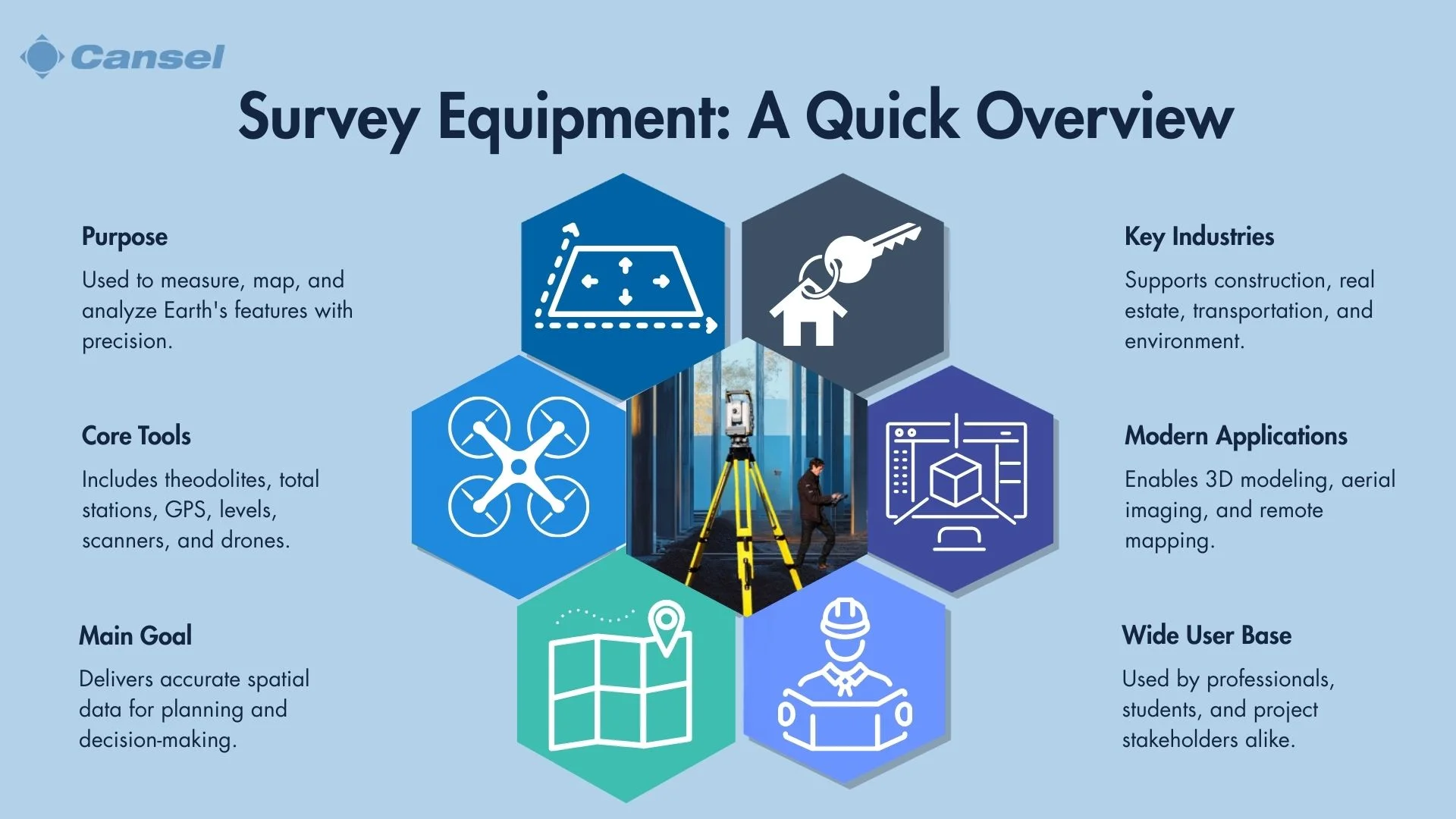
Survey equipment encompasses a broad array of tools and instruments used by professionals in the field of surveying to measure, map, and analyze the Earth's surface and features. This equipment is essential for accurately determining spatial relationships, dimensions, and topography, facilitating the planning and execution of construction, development, and mapping projects.
The most important goal of survey equipment is to provide precise and reliable data that supports decision-making and planning in various industries, including construction, real estate, transportation, and environmental management.
At the core of survey equipment is the goal to accurately capture the physical characteristics of a location. This involves tools such as:
- Theodolites, which measure horizontal and vertical angles
- Total stations like the Trimble S7 5 Second Robotic Total Station, which integrate electronic distance measurement and angle measurement to calculate exact positions
- GPS systems, which offer global positioning data with high accuracy
- Levels, which are used for determining elevation differences
- Laser scanning and drone technology, which enable the capture of detailed 3D models and aerial images of landscapes and structures.
Understanding search intent, individuals looking into survey equipment are likely seeking information on the types of tools available, their uses, and how they contribute to the accuracy and efficiency of surveying tasks. They might be professionals in the field evaluating new technologies, students learning about surveying practices, or stakeholders in projects that require surveying services.
The networks of meaning surrounding survey equipment also include its application in environmental conservation, where it's used to monitor changes in natural landscapes, and in archaeology, for mapping excavation sites without disturbing artifacts.
Overall, survey equipment is integral to accurately measuring and mapping the physical world, supporting a wide range of professional activities from construction to conservation. Its evolution continues to enhance the precision, efficiency, and scope of surveying practices, meeting the diverse needs of today's complex projects and research endeavors.
Why Consider Renting Survey Equipment?
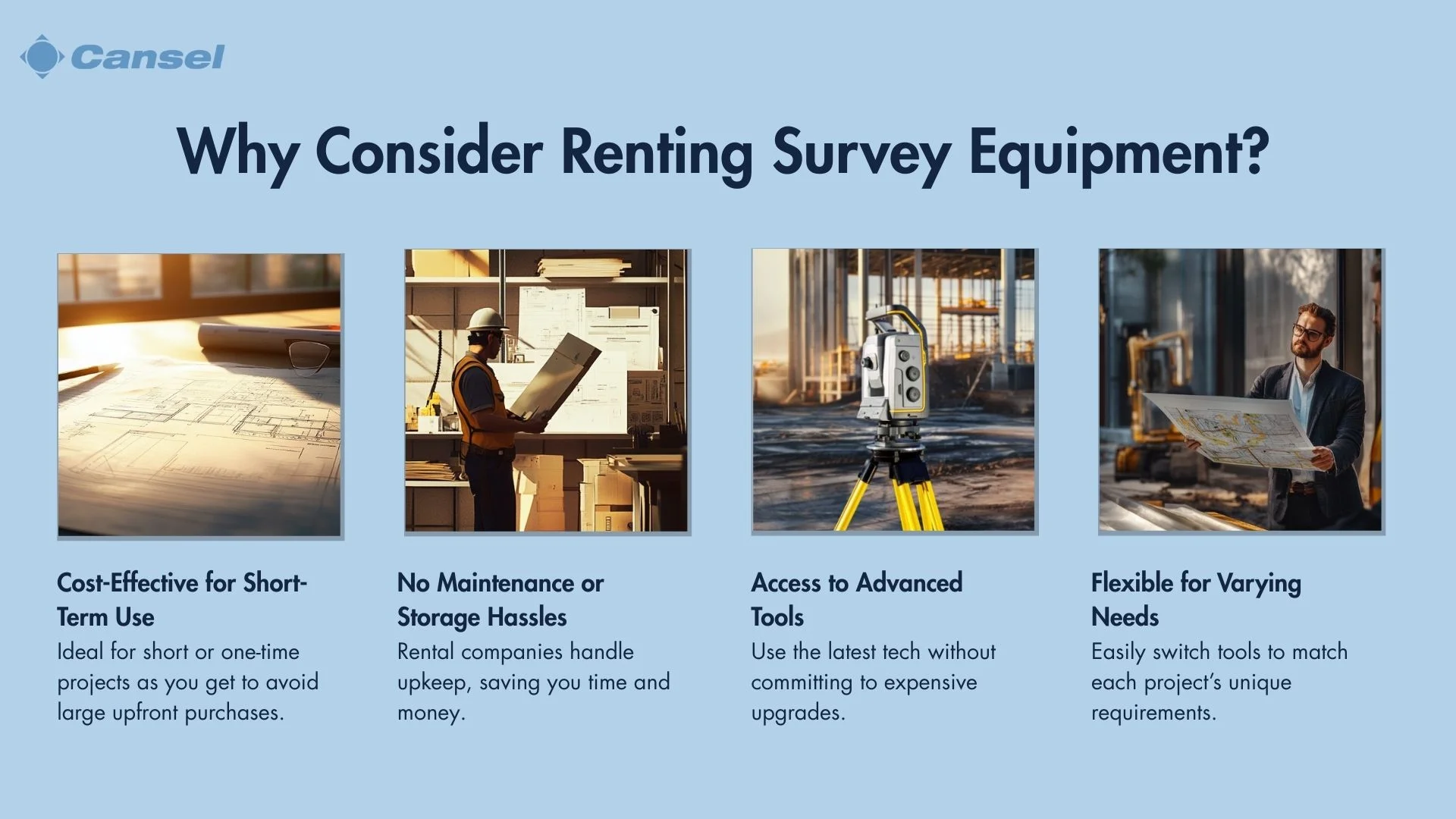
Renting survey equipment offers a cost-effective solution for short-term or one-off projects, eliminating the need for a large initial investment in technology that might only be needed temporarily. This option provides access to the latest technology, ensuring that projects benefit from the most advanced tools without the financial burden of purchasing and updating equipment. Additionally, renting removes the concerns associated with maintenance, repair, and storage costs, as these responsibilities typically fall to the rental company.
It also offers the flexibility to change equipment based on specific project needs, allowing surveyors to use the most appropriate and efficient tools for each task. This adaptability is particularly valuable in a field where project requirements can vary significantly. For professionals and companies that face varying surveying demands, renting equipment can be a strategic choice that aligns with both project goals and financial considerations, ensuring that resources are optimally allocated.
One flexible rental solution is the Cansel Elite Survey Equipment Program, which is a specialized option offering access to high-performance equipment on 12 to 36-month terms. This program is designed specifically for companies that are just starting out or those unable to commit capital to large equipment purchases but still need reliable gear for larger or recurring projects.
Cost-effective for Short-term or One-off Projects
Renting survey equipment proves to be financially advantageous for projects with limited durations or unique requirements, sidestepping the substantial expense tied to outright purchases.
Access to the Latest Technology Without a Large Investment
Renting equipment empowers users to employ cutting-edge survey tools without the financial burden of owning, thereby bypassing the high costs associated with buying and periodically upgrading equipment.
Eliminates Maintenance, Repair, and Storage Costs
Choosing to rent removes the financial and logistical responsibilities of equipment upkeep, repairs, and storage, as these aspects are managed by the rental provider, offering peace of mind and cost savings.
Flexibility to Change Equipment Based on Project Needs
Renting offers unparalleled adaptability, enabling the selection of the most suitable and efficient survey instruments for each specific project, thus enhancing overall productivity and ensuring accuracy.
Why Consider Buying Survey Equipment?
Buying survey equipment is a strategic investment for businesses and professionals engaged in frequent, long-term projects, offering significant cost savings over time compared to renting.
Ownership ensures immediate and constant access to tools, eliminating delays and dependency on rental availability. It allows for customization and deep familiarity with the equipment, leading to increased efficiency and precision in surveying tasks.
Additionally, purchasing survey equipment can offer potential tax benefits and the opportunity for depreciation, further enhancing its financial attractiveness. For entities with a steady demand for surveying capabilities, the decision to buy can solidify operational readiness and financial optimization.
Long-term Cost Savings Over Multiple Projects
Owning survey equipment results in substantial long-term cost savings, especially for businesses engaged in frequent or prolonged projects, eliminating the need for repetitive rental expenses. For example, if you take on a lot of projects that involve navigating inaccessible areas or hazardous terrain, purchasing a drone like the DJI Matrice 400 can save you a lot of time and protect your surveying team.
Immediate and Constant Access, No Waiting on Rentals
Acquiring your own equipment ensures immediate and uninterrupted access, eradicating the delays and uncertainties that come with relying on rental availability, thus safeguarding project timelines.
Customization and Familiarity with Your Own Equipment
Ownership affords the opportunity for personal customization and fosters a deep familiarity with the equipment's functionality, significantly boosting efficiency and precision in survey-related tasks.
Potential Tax Benefits and Depreciation
Investing in survey equipment can offer notable financial incentives, including tax deductions and the opportunity for depreciation, enhancing the overall economic appeal of purchasing over renting.
Factors to Decide Between Rental and Purchase
Deciding whether to rent or purchase survey equipment hinges on several key factors, each critical to determining the most cost-effective and operationally efficient choice.
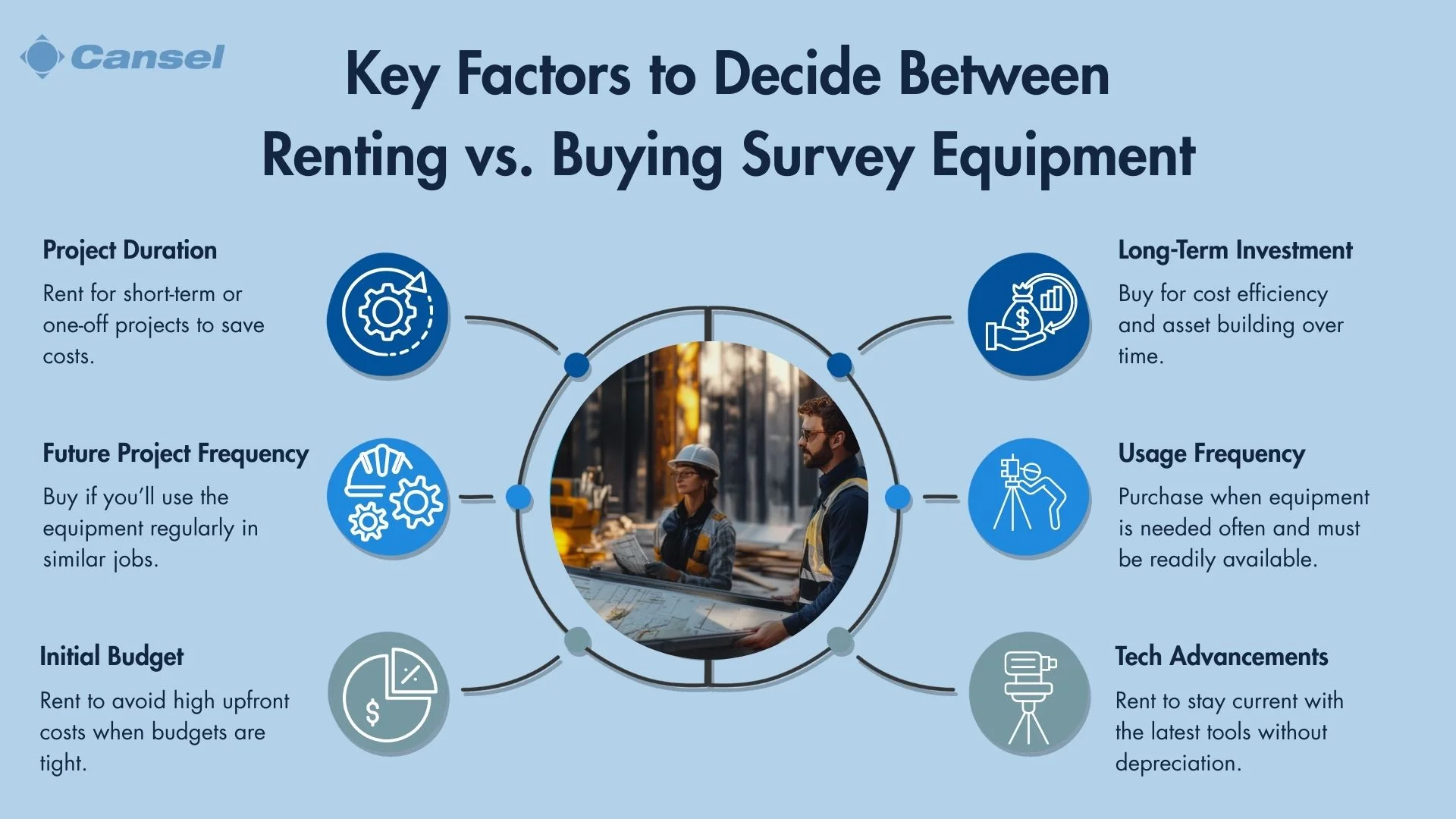
Let’s break down the six factors which collectively guide businesses and professionals in making an informed decision that aligns with their operational needs and financial strategies.
Project Duration and Frequency of Similar Future Projects
Short-term or occasional projects lean towards the benefits of renting, offering cost efficiency and flexibility without the commitment required for purchase, ideal for those with infrequent similar future project needs.
Initial Budget vs. Long-Term Investment Considerations
When facing an initially constrained budget, renting emerges as a viable option to mitigate large upfront costs. Conversely, a strategy focused on long-term financial efficiency and asset building supports the case for purchasing.
Equipment Usage Frequency and Its Availability
High usage frequency and the necessity for constant equipment availability underscore the advantages of owning survey equipment, eliminating potential delays and ensuring readiness for immediate project commencement. For this reason, many surveyors opt to purchase equipment like data collectors; as virtually all projects will need mapping and rapid collection, tools like the Trimble TSC7 V2 Data Collector may be worth purchasing instead.
Rate of Technology Advancement in Needed Equipment
Given the rapid technological advancements in surveying tools, renting provides an attractive pathway to continually access the most up-to-date equipment, avoiding the depreciation and obsolescence risks tied to purchasing.
Evaluating The Cost-Effectiveness of Renting vs. Buying
Evaluating the cost-effectiveness of renting versus buying survey equipment necessitates a comprehensive analysis that extends beyond initial expenses to consider the full spectrum of financial implications over the equipment's lifecycle.
This analysis begins with calculating the total rental costs for the anticipated duration of a project, including any associated fees such as delivery, setup, and potential overage charges. These figures are then compared against the purchase price of the equipment, factoring in ongoing expenses like maintenance, repair, and storage, to ascertain the long-term financial impact.
Additionally, the evaluation must account for potential downtime costs if owned equipment fails and the project is delayed, as well as the benefits of depreciation and the resale value of purchased equipment.
This thorough financial comparison, grounded in the specific needs and circumstances of the user, ultimately guides the decision towards the option that offers the greatest economic advantage while ensuring project needs are met efficiently.
Calculate Total Rental Costs for the Project's Duration
Determine the overall expense of renting survey equipment by summing up the rental rates for the entire duration of the project, providing a comprehensive financial insight.
Include Delivery, Setup, and Potential Overage Fees
Account for additional costs associated with renting, such as delivery charges, setup fees, and potential overages, to ensure an all-encompassing assessment of expenses.
Compare Against Purchase Price, Maintenance, and Storage
Weigh the total rental costs against the initial purchase price of the equipment, incorporating long-term expenses like maintenance and storage, to gauge the overall cost-effectiveness.
Factor in Potential Downtime Costs if Owned Equipment Fails
Consider the financial impact of potential downtime due to equipment failure, evaluating the cost implications of project delays against the flexibility benefits offered by rentals.
Consider Resale Value and Depreciation if Purchasing
Evaluate the resale value and depreciation of purchased equipment as critical components of the investment's return, influencing the comprehensive financial comparison between renting and buying.
Additional Considerations
Beyond the direct financial implications of renting versus buying survey equipment, there are additional considerations that can influence the decision-making process.
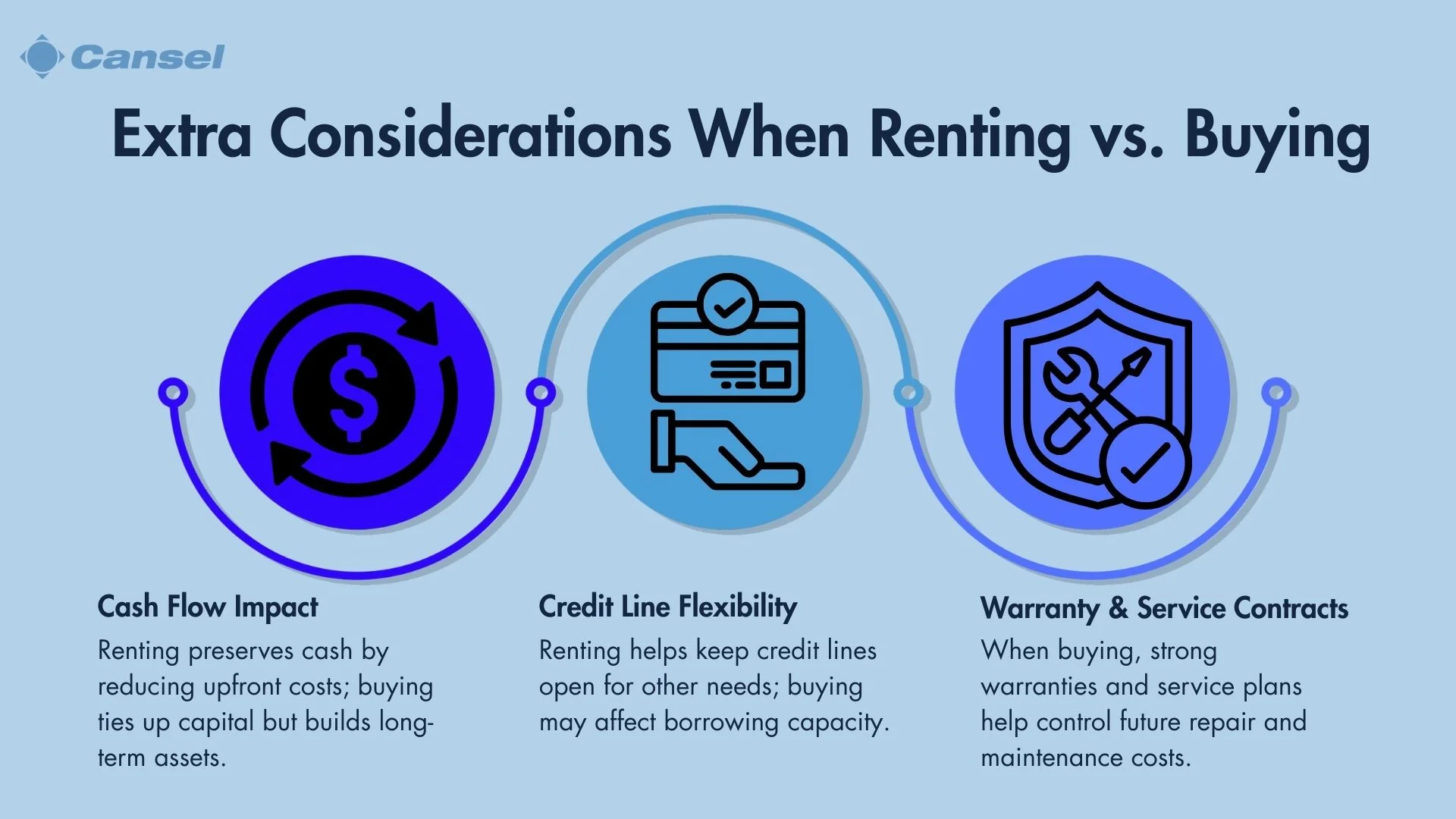
The impact on cash flow is a critical factor, as renting may require less immediate outlay of funds. Conversely, purchasing equipment can strain cash reserves but may result in long-term savings and asset accumulation.
Credit lines may also be affected, as the choice between renting and buying could influence a business's borrowing capacity and financial leverage. Moreover, when opting to purchase, evaluating warranty and service contracts is essential to understand the scope of protection and support for the equipment, potentially mitigating future financial risks associated with repairs and maintenance.
These considerations add layers of complexity to the decision, requiring a holistic approach to determine the most strategic option that aligns with both immediate and future business needs and objectives.
Impact on Cash Flow and Credit Lines
Renting survey equipment can have a positive impact on cash flow, minimizing initial cash outlays and preserving liquidity for other critical investments or operational needs. This approach can also help maintain available credit lines for future endeavors or unexpected expenses. On the other hand, purchasing requires a significant upfront investment but can enhance a company’s asset base and equity over the long term, potentially influencing creditworthiness differently.
Warranty and Service Contracts if Purchasing
Investigating warranty and service contracts is vital when purchasing survey equipment. For example, the Trimble S7 3 Second Robotic Total Station comes with a two-year warranty; periods vary between providers.
These agreements serve as a safeguard, covering future repair costs and maintenance issues, thus ensuring the equipment's longevity and optimal performance. They are a key factor in the purchasing decision, offering peace of mind and financial predictability by mitigating unforeseen expenses associated with equipment upkeep.
Making the Informed Choice for Your Needs
Deciding whether to rent or buy survey equipment is a multifaceted decision that hinges on understanding the specific needs, financial implications, and long-term objectives of your projects or business. Balancing initial expenses against long-term benefits, while factoring in maintenance costs, availability, and the rate of technological advancement, enables a well-rounded evaluation.
Additionally, understanding the impact on cash flow, credit lines, and the value of warranties and service contracts further informs this decision. Ultimately, making an informed choice requires a comprehensive analysis of these factors, tailored to your unique operational and financial context, ensuring that the decision to rent or purchase aligns with your strategic goals and provides the best return on investment.